

Lower that pressure, one brisk step at a time: A Current Scientific Review of Cardio’s Critical Role in Blood pressure and Hypertension management At Any Age

Cardiorespiratory exercise (also referred to as “cardio”) refers to any intentional, coordinated physical activity that increases the heart and breathing rate for a sustained period of time while engaging large muscle groups in order to improve the efficacy of your heart, lungs, and circulatory system. Common examples of cardio are walking, hiking, swimming, jogging, running, and cycling but can also include other modalities such as stair climbing, dancing, jumping rope, and higher intensity yoga. Cardiorespiratory exercise is touted as the cornerstone in the clinical recommendations for prevention and management of high blood pressure (hypertension) across diverse populations. Today, we review the scientific literature on the supported benefits and applications of cardio for blood pressure and hypertension management, as well as practical recommendations to begin implementing cardio exercise into your daily health routine [1] [2] [8] [9] [10] [18].
Exploring The Benefits of Cardiorespiratory Exercise for Blood Pressure
Significant Blood Pressure Reduction:
Broadly speaking, exercise has shown to consistently lower blood pressure in both generally health adults and those suffering from hypertension. Aerobic exercise (indicating “with oxygen” or the use of oxygen to meet energy demands), dynamic resistance training, and combined exercise modalities (ex. HIIT and team sports) have all been found to significantly lower both systolic and diastolic blood pressure in individuals with hypertension, per recent meta analyses. Reductions tend to range between 4-8 mm Hg (millimeters of Mercury) for systolic blood pressure (the upper number), and 2-5 mm Hg for diastolic pressure (the lower number). Scientific findings points to the greater effects on blood pressure improvement being seen in those with higher baseline blood pressures, meaning those who already suffer from high blood pressure are likely to see the greater improvements upon starting consistent exercise interventions [1] [2] [3] [4] [5] [6].
2. Ambulatory and Office BP Improvements:
Clinical research has found that blood pressure improvements from exercise aren’t just seen momentarily after exercise sessions using single-check blood pressure readings during doctor’s visits or at home. Use of 24-hour ambulatory blood pressure monitoring systems (ABPMs) provide a more accurate picture of a person’s blood pressure, as it captures readings throughout the day including during normal daily activities and throughout sleep. A recent meta analysis found that following aerobic exercise, through use of ABPMs, that there was a significant reduction in 24-hour ambulatory blood pressure readings across the day. Benefits appear to be especially pronounced in individuals supported on anti-hypertensive medications compared to those not on medications. Even those suffering from a more challenging type of hypertension, known as resistant hypertension, saw benefit in 24-hour ambulatory blood pressure from engaging in cardio exercise interventions. These findings are promising as 24-hour ambulatory blood pressure metrics are a strong predictor of overall cardiovascular disease risk [2] [7] [8] [9].
3. Enhanced Cardiovascular Health:
As the name may indicate, cardiorespiratory exercise is one of the greatest ways to improve cardiorespiratory fitness (CRF), which is the ability of circulatory and respiratory systems to supply oxygen to skeletal muscle and remove waste products during sustained physical activity. Improvements in CRF from exercise have been linked to significant reduction in cardiovascular disease and all-cause mortality. For those recently diagnosed with cardiovascular disease or with a high genetic predisposition, this is welcoming news as including cardio can reduce the risk of death from heart complications. CRF improvements are also linked to other health benefits, including improved endothelial functioning (circulation), reduced inflammation (acute and chronic), and greater autonomic nervous system balance (involuntary bodily function interactions to support overall well-being) [6] [10] [11].
4. Additional Health Gains:
While much of the research focuses on aerobic or resistance exercise on blood pressure management, newer research is investigating the impact of combined exercise modalities (aerobic plus resistance) as well as adjunctive practices (such as meditation and mindful breathing exercises). Recent literature findings points towards improvements in lipid profiles, CRF, and psychological stress levels from combined exercise and adjunctive exercise modalities. These findings offer benefit in understanding the holistic impact of adding these modalities to exercise programs and practices to offer a more holistic approach to hypertension management [6] [12].
Current Exercise Recommendations and Guidelines
Type: Aerobic exercise is most strongly recommended for improvement in blood pressure for those with elevated levels. Dynamic resistance and isometric exercises (such as wall squats or handgrip) also provide significant benefits, with isometric training showing the largest reductions in blood pressures in some analyses compared to resistance [1] [3] [13].
Frequency and Duration: Most organizational guidelines recommend at least 150 minutes per week of moderate-intensity aerobic activity, or 75 minutes of vigorous-intensity activity, spread over 3–5 days per week. Sessions are encouraged to last at least 30 minutes in duration, but newer research has not shown that shorter durations are any less effective or beneficial [14] [15] [16].
Intensity: Moderate-to-vigorous intensity is often seen to be the most effective on providing heath benefits, but even low-to-moderate intensity can yield substantial blood pressure reductions, especially when sustained over weeks to months. A simple way to determine your exercise intensity is to use the talk test; in which low-intensity work is one that you can sing a song while doing without becoming short of breath, moderate-intensity is one that you can talk while doing but not sing, and vigorous-intensity is one you can’t say more than a few words without pausing for breath [5] [17].
Personalization: Exercise prescriptions should be tailored to the individual’s baseline blood pressure (for those with hypertension), active comorbidities, and personal preferences. Clinically supervised programs may offer safer environments for those with significant disease burden to support ascertainment of these benefits, particularly for those with resistant hypertension or other high-risk health concerns such as those with symptomatic cardiovascular, metabolic, or renal diseases [3] [7] [11].
Table: Exercise Modalities and Blood Pressure Effects
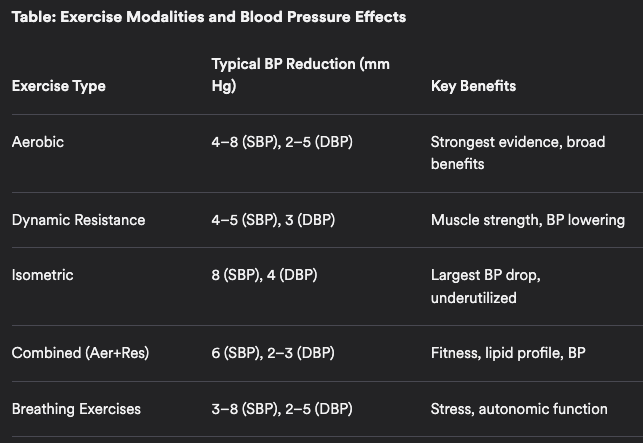
Figure 1: Summary of exercise types and their impact on blood pressure [1] [2] [4] [6] [11] [18] [19] [20].
Practical Takeaways and Application
Cardiorespiratory exercise, which includes activities such as brisk walking, running, cycling, and swimming, has been shown to significantly lower blood pressure in people with and without hypertension. Consistent moderate-to-high intensity aerobic exercise has been shown to reduce blood pressure by 4-8 mm Hg systolic and 2-5 mm Hg diastolic, pointing to an impactful non-pharmacological treatment option in the management of high blood pressure. Benefits are not exclusively seen in medical clinics during doctor’s visits, however, but also in daily ambulatory blood pressures, which is a strong predictor of cardiovascular risk and mortality [1] [2] [7].
Different types of exercise, such as aerobic, resistance, and isometric training, all are seen to contribute to blood pressure reduction. Aerobic exercise appears to provide the greatest improvement in both blood pressure control and cardiorespiratory fitness improvement per recent meta analyses. These benefits are seen across various populations and age groups, including older adults with resistant hypertension diagnoses. Additional benefits seen include improvement in cholesterol levels and body composition towards healthier levels of muscle and fat mass. The positive effects of exercise are independent of age, sex, and comorbidities, which is why it remains a recommended first-line therapy in most major hypertension guidelines to this day. In summary, incorporating and scheduling regular cardiorespiratory exercise into your daily life, however that may look for you, is a powerful and accessible strategy to support and improve blood pressure control and overall heart health for all of us [3] [4] [5] [6] [9] [10].
Cardiorespiratory exercise is safe and effective for most adults with hypertension.
Start with light-to-moderate-intensity aerobic activity when starting out, and consider adding resistance or isometric exercises for additional benefit. Speak with your physician or cardiologist before starting higher-intensity aerobic exercise to ensure it is safe for you to do so.
Consistency is key— health and heart benefits accrue with regular, sustained activity.
References
1. Edwards, J., Deenmamode, A., Griffiths, M., Arnold, O., Cooper, N., Wiles, J., & O’Driscoll, J. Exercise training and resting blood pressure: a large-scale pairwise and network meta-analysis of randomised controlled trials. British Journal of Sports Medicine. 2023; 57. https://doi.org/10.1136/bjsports-2022-106503.
2. Saco-Ledo, G., Valenzuela, P., Ruiz‐Hurtado, G., Ruilope, L., & Lucia, A. Exercise Reduces Ambulatory Blood Pressure in Patients With Hypertension: A Systematic Review and Meta‐Analysis of Randomized Controlled Trials. Journal of the American Heart Association: Cardiovascular and Cerebrovascular Disease. 2020; 9. https://doi.org/10.1161/jaha.120.018487.
3. Hanssen, H., Boardman, H., Deiseroth, A., Moholdt, T., Simonenko, M., Kränkel, N., Niebauer, J., Tiberi, M., Abreu, A., Solberg, E., Pescatello, L., Brguljan, J., Coca, A., & Leeson, P. Personalized exercise prescription in the prevention and treatment of arterial hypertension: a Consensus Document from the European Association of Preventive Cardiology (EAPC) and the ESC Council on Hypertension.. European Journal of Preventive Cardiology. 2021 https://doi.org/10.1093/eurjpc/zwaa141.
4. Pescatello, L., Franklin, B., Fagard, R., Farquhar, W., Kelley, G., & Ray, C. Exercise and Hypertension. Medicine and Science in Sports and Exercise. 2004; 36. https://doi.org/10.1249/01.mss.0000115224.88514.3a.
5. Hagberg, J., Park, J., & Brown, M. The Role of Exercise Training in the Treatment of Hypertension. Sports Medicine. 2000; 30. https://doi.org/10.2165/00007256-200030030-00004.
6. Boeno, F., Ramis, T., Munhoz, S., Farinha, J., Moritz, C., Leal-Menezes, R., Ribeiro, J., Christou, D., & Reischak-Oliveira, A. Effect of aerobic and resistance exercise training on inflammation, endothelial function and ambulatory blood pressure in middle-aged hypertensive patients.. Journal of Hypertension. 2020 https://doi.org/10.1097/hjh.0000000000002581.
7. Lopes, S., Mesquita-Bastos, J., Garcia, C., Bertoquini, S., Ribau, V., Teixeira, M., Ribeiro, I., Melo, J., Oliveira, J., Figueiredo, D., Guimãraes, G., Pescatello, L., Polónia, J., Alves, A., & Ribeiro, F. Effect of Exercise Training on Ambulatory Blood Pressure Among Patients With Resistant Hypertension: A Randomized Clinical Trial.. JAMA cardiology. 2021 https://doi.org/10.1001/jamacardio.2021.2735.
8. Lopes, S., Mesquita-Bastos, J., Teixeira, M., Figueiredo, D., Oliveira, J., Polónia, J., Alves, A., & Ribeiro, F. Aerobic exercise training reduces blood pressure, angiotensin II and oxidative stress of patients with resistant hypertension: the EnRiCH trial. European Heart Journal. 2021 https://doi.org/10.1093/eurheartj/ehab724.2392.
9. Dimeo, F., Pagonas, N., Seibert, F., Arndt, R., Zidek, W., & Westhoff, T. Aerobic Exercise Reduces Blood Pressure in Resistant Hypertension. Hypertension. 2012; 60. https://doi.org/10.1161/hypertensionaha.112.197780.
10. Kokkinos, P. Cardiorespiratory fitness, exercise, and blood pressure.. Hypertension. 2014; 64 6. https://doi.org/10.1161/hypertensionaha.114.03616.
11. Deng, Y., Zeng, X., Tang, C., Hou, X., Zhang, Y., & Shi, L. The effect of exercise training on heart rate variability in patients with hypertension: A systematic review and meta-analysis. Journal of Sports Sciences. 2024; 42. https://doi.org/10.1080/02640414.2024.2388984
12. Herawati, I., Ludin, A., Ishak, I., Mutalazimah, M., & Farah, N. Impact of combined high-intensity bodyweight interval training and breathing exercise on cardiometabolic health in normal-weight middle-aged adults with hypertension. BMC Public Health. 2025; 25. https://doi.org/10.1186/s12889-025-22139-y.
13. Edwards, J., Coleman, D., Ritti-Dias, R., Farah, B., Stensel, D., Lucas, S., Millar, P., Gordon, B., Cornelissen, V., Smart, N., Carlson, D., McGowan, C., Swaine, I., Pescatello, L., Howden, R., Bruce-Low, S., Farmer, C., Leeson, P., Sharma, R., & O'Driscoll, J. Isometric Exercise Training and Arterial Hypertension: An Updated Review. Sports Medicine (Auckland, N.z.). 2024; 54. https://doi.org/10.1007/s40279-024-02036-x.
14. Lin, M., Lin, Y., Li, Y., & Lin, X. Effect of exercise training on blood pressure variability in adults: A systematic review and meta-analysis. PLOS ONE. 2023; 18. https://doi.org/10.1371/journal.pone.0292020.
15. Pescatello, L., MacDonald, H., Ash, G., Lamberti, L., Farquhar, W., Arena, R., & Johnson, B. Assessing the Existing Professional Exercise Recommendations for Hypertension: A Review and Recommendations for Future Research Priorities.. Mayo Clinic proceedings. 2015; 90 6. https://doi.org/10.1016/j.mayocp.2015.04.008.
16. Pastore, M., Cavigli, L., Olivoni, G., Morrone, F., Amati, F., Imbalzano, E., Rinaldi, A., Liga, R., Mattioli, A., Scicchitano, P., Curcio, A., Barillà, F., Ciccarelli, M., Maestrini, V., Filardi, P., D'ascenzi, F., & Cameli, M. Physical exercise in hypertensive heart disease: From the differential diagnosis to the complementary role of exercise.. International journal of cardiology. 2024 https://doi.org/10.1016/j.ijcard.2024.132232.
17. Mølmen-Hansen, H., Stølen, T., Tjønna, A., Aamot, I., Ekeberg, I., Tyldum, G., Wisløff, U., Ingul, C., & Støylen, A. Aerobic interval training reduces blood pressure and improves myocardial function in hypertensive patients. European Journal of Preventive Cardiology. 2012; 19. https://doi.org/10.1177/1741826711400512.
18. Ferreira, J., Plentz, R., Stein, C., Casali, K., Arena, R., & Lago, P. Inspiratory muscle training reduces blood pressure and sympathetic activity in hypertensive patients: a randomized controlled trial.. International journal of cardiology. 2013; 166 1. https://doi.org/10.1016/j.ijcard.2011.09.069.
19. Boeno, F., Ramis, T., Munhoz, S., Farinha, J., Moritz, C., Leal-Menezes, R., Ribeiro, J., Christou, D., & Reischak-Oliveira, A. Effect of aerobic and resistance exercise training on inflammation, endothelial function and ambulatory blood pressure in middle-aged hypertensive patients.. Journal of Hypertension. 2020 https://doi.org/10.1097/hjh.0000000000002581.
20. Edwards, J., Coleman, D., Ritti-Dias, R., Farah, B., Stensel, D., Lucas, S., Millar, P., Gordon, B., Cornelissen, V., Smart, N., Carlson, D., McGowan, C., Swaine, I., Pescatello, L., Howden, R., Bruce-Low, S., Farmer, C., Leeson, P., Sharma, R., & O'Driscoll, J. Isometric Exercise Training and Arterial Hypertension: An Updated Review. Sports Medicine (Auckland, N.z.). 2024; 54. https://doi.org/10.1007/s40279-024-02036-x.