

Sleepless Nights and Hurting Hearts: Understanding The Hidden Link Between Poor Sleep and heart Health

We all have felt the effects of a great night of sleep, and those of poor or little sleep. We value sleep, but don’t always give it the attention it deserves. We often think of sleep as a luxury throughout the work week - something we sacrifice for a few more hours of work or social media scrolling, late night hangouts with friends or colleagues, or staying up stressing about a big presentation or the upcoming tax season. Maybe we think we can offset these poor sleep hygiene practices on our weekends when we sleep in longer. But what if skipping out on sleep wasn’t just making you groggy and irritable the next day, but quietly harming your heart and taking years off of your life in the long-term? Poor sleep has been consistently shown to lead to increased heart disease risk, elevated blood pressure, altered metabolism, and systemic inflammation. Today, we will dive into the current research and discover how important sleep is for our health, our hearts, and our longevity.
How Poor Sleep Affects the Heart
Understanding how poor sleep impacts heart health is crucial for anyone aiming to protect their cardiovascular well-being. Research consistently shows that both the quantity and quality of sleep play a significant role in heart health. Poor sleep patterns consistently show increased risk in development of deleterious health conditions like hypertension, coronary artery disease, stroke, and heart failure [1] [2] [3] [4] [5] [6] [7] [8] [9] [10] [11].
Sleep is not just a time for rest—it's when the body repairs itself and regulates vital functions such as hormones, cellular repair and growth, and memory consolidation. Insufficient or disrupted sleep can lead to increased blood pressure, higher levels of stress hormones (such as cortisol), impaired glucose metabolism, and chronic inflammation, all of which are established risk factors for cardiovascular disease. Sleep loss also increases the risk for development of obesity and type 2 diabetes—both major heart disease risk factor—due to significant impacts on metabolism and appetite regulation. Sleep disorders such as insomnia, sleep apnea, and irregular sleep schedules further elevate these risks if left untreated for a prolonged period of time [1] [2] [3] [7] [12] [10] [11] [13] [14] [15].
Key Research Findings
The Links Between Sleep and Heart Disease
Short sleep duration (less than 7 hours for all adults) and poor sleep quality are associated with higher risks of coronary heart disease, stroke, and hypertension [1] [2] [3] [4] [5] [7] [9] [11].
Irregular sleep patterns and frequent changes in sleep timing (time initiating sleep and time waking up) increase the likelihood of cardiovascular events, independent of all other risk factors [6] [13].
Sleep disorders, like insomnia and sleep apnea, are strongly linked to elevated cardiovascular disease risk as they promote similar negative disturbances and dysregulation of vital bodily processes as getting consistently poor or insufficient sleep [2] [7] [14] [15] .
While tracking sleep quality and duration are valuable health metrics to identify discrepancies, they are not the end-all-be-all of your risk for disease development from poor sleep. Multi-dimensional sleep health—considering duration, quality, regularity, and absence of disorders—provides a more accurate prediction of heart disease risk than any single sleep metric alone, including any arbitrary “Sleep Score” from wearable health tracking technology [6] [15].
Mechanisms at Play
Poor sleep can disrupt the autonomic nervous system, increase inflammation, impair metabolic regulation, and promote endothelial dysfunction, all contributing to the development of cardiovascular disease. Prolonged lack of adequate sleep elevates cortisol and other stress hormone levels, contributing to arterial inflammation and the progressive build-up of plaque along the arterial walls. Insufficient restful sleep disrupts our body’s ability to regulate blood pressure the next day through insufficient hormonal replacement, which overtime can compound to development of hypertension. Lastly, even a single night of poor sleep has shown alteration in whole-body immune cell profiles, mimicking patterns of inflammation which can contribute to inflammation-driven health conditions such as obesity, diabetes, and heart disease [1] [2] [3] [10] [11] [12].
Who Is Most at Risk from poor sleep?
Middle-aged adults, shift workers (especially overnight shifters), and those with multiple sleep problems are particularly vulnerable per the most recent research findings. Both men and women are affected equally, though the optimal sleep duration for minimizing heart disease risk may differ slightly by gender. It should not be understated that poor sleep causes harm and damage to the heart and body at any age, even in children and adolescents. Adopting good sleep hygiene practices and avoiding disorganized sleep patterns during school ages is vital to promoting greater disease risk mitigation through later stages of life [11] [16].
Can Better Sleep REally Help My Heart?
It most definitely can! Improving your sleep now versus later (whenever that may be) is always preferred and mitigates the risk of disease development or adverse health event occurrence. Adopting healthy sleep habits—such as maintaining a regular sleep schedule, aiming for 7–9 hours of quality sleep, and addressing sleep disorders—can significantly reduce the lifelong risk of heart disease development or worsening of current cardiovascular diseases [4] [6] [8] [15] [17] [18].
Table: Sleep Factors and Heart Disease Risk
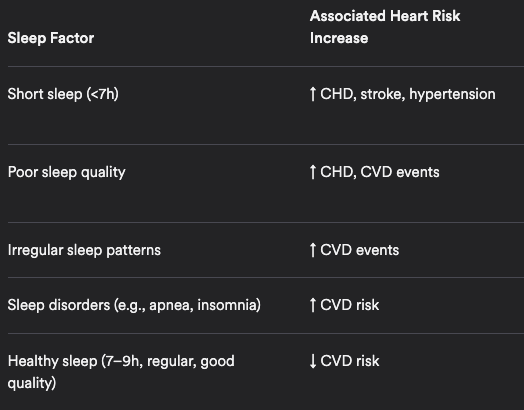
Figure 1: Summary of how different sleep factors impact heart disease risk. CHD= Coronary Heart Disease. CVD = Cardiovascular Disease. [1] [2] [3] [4] [5] [6] [8] [9] [10] [12] [13] [16] [17] [18] [19] [20]
Key Takeaways
Sleep is not a passive state of being — it’s an active state for bodily recovery, rejuvenation, and sustainability. By not getting sufficient sleep today, you are harming your future heart health and overall well-being. Addressing sleep problems promptly with appropriate medical professionals and maintaining healthy sleep habits for the long-term can markedly lower your risk of cardiovascular disease and improve overall wellness. The act of prioritizing consistent, high-quality sleep is a powerful, modifiable way to protect your heart today and every day.
At Wholehearted Nutrition and Wellness PLLC, we strongly believe that good nutrition and wellness is more than just fancy marketing terms or unattainable goals for another day. Creating approachable, progressive, achievable, and sustainable nutrition and wellness plans is how we make these health goals and milestone a reality today. We recognize why nutrition and exercise deserves center stage in cardiovascular disease management and prevention. If you’re interested in beginning your nutrition and wellness journey to improve your heart health, or are just seeking guidance on how to manage your heart disease through nutrition, book an appointment with us today and begin your health journey. We strive to support you in healing the heart while nourishing the whole.
References
1. Tobaldini, E., Fiorelli, E., Solbiati, M., Costantino, G., Nobili, L., & Montano, N. Short sleep duration and cardiometabolic risk: from pathophysiology to clinical evidence. Nature Reviews Cardiology. 2019; 16. https://doi.org/10.1038/s41569-018-0109-6.
2. Miller, M., & Howarth, N. Sleep and cardiovascular disease. Emerging Topics in Life Sciences. 2023; 7. https://doi.org/10.1042/etls20230111.
3. Yang, C., Yan, P., Wu, X., Zhang, W., Cui, H., Zhang, L., Xu, Z., Peng, S., Tang, M., Wang, Y., Chen, L., Zou, Y., Liu, Y., Zhang, M., Zhao, X., Xiao, J., Xiao, C., Zhang, L., Yao, Y., Li, J., Liu, Z., Yang, C., Jiang, X., & Zhang, B. Associations of sleep with cardiometabolic risk factors and cardiovascular diseases: An umbrella review of observational and mendelian randomization studies.. Sleep medicine reviews. 2024; 77. https://doi.org/10.1016/j.smrv.2024.101965.
4. Zhang, X., Wang, D., & Liu, J. Associations of sleep pattern, sleep duration, bedtime, rising time and cardiovascular disease: Data from NHANES (2017–2020). PLOS One. 2025; 20. https://doi.org/10.1371/journal.pone.0326499.
5. Kwok, C., Kontopantelis, E., Kuligowski, G., Gray, M., Muhyaldeen, A., Gale, C., Peat, G., Cleator, J., Chew‐Graham, C., Loke, Y., & Mamas, M. Self‐Reported Sleep Duration and Quality and Cardiovascular Disease and Mortality: A Dose‐Response Meta‐Analysis. Journal of the American Heart Association: Cardiovascular and Cerebrovascular Disease. 2018; 7. https://doi.org/10.1161/jaha.118.008552.
6. Lee, S., Mu, C., Wallace, M., Andel, R., Almeida, D., Buxton, O., & Patel, S. Sleep health composites are associated with the risk of heart disease across sex and race. Scientific Reports. 2022; 12. https://doi.org/10.1038/s41598-022-05203-0.
7. Wipper, B., Mayer-Suess, L., Cesari, M., Ibrahim, A., Winkelman, J., & Kiechl, S. Relationship of Suboptimal and Disordered Sleep with Cardiovascular Disease and Its Risk Factors – A Narrative Review. Neuroepidemiology. 2024; 59. https://doi.org/10.1159/000539369.
8. Onyegbule, C., Muoghalu, C., Ofoegbu, C., & Ezeorah, F. The Impact of Poor Sleep Quality on Cardiovascular Risk Factors and Quality of Life. Cureus. 2025; 17. https://doi.org/10.7759/cureus.77397.
9. Lao, X., Liu, X., Deng, H., Chan, T., Ho, K., Wang, F., Vermeulen, R., Tam, T., Wong, M., Tse, L., Chang, L., & Yeoh, E. Sleep Quality, Sleep Duration, and the Risk of Coronary Heart Disease: A Prospective Cohort Study With 60,586 Adults.. Journal of clinical sleep medicine : JCSM : official publication of the American Academy of Sleep Medicine. 2018; 14 1. https://doi.org/10.5664/jcsm.6894.
10. Yan, B., Yang, J., Zhao, B., Fan, Y., Wang, W., & , X. Objective Sleep Efficiency Predicts Cardiovascular Disease in a Community Population: The Sleep Heart Health Study. Journal of the American Heart Association: Cardiovascular and Cerebrovascular Disease. 2021; 10. https://doi.org/10.1161/jaha.120.016201.
11. Pan, Y., Zhou, Y., Shi, X., He, S., & Lai, W. The association between sleep deprivation and the risk of cardiovascular diseases: A systematic meta‑analysis. Biomedical Reports. 2023; 19. https://doi.org/10.3892/br.2023.1660.
12. Liu, H., & Chen, A. Roles of sleep deprivation in cardiovascular dysfunctions. Life Sciences. 2019; 219. https://doi.org/10.1016/j.lfs.2019.01.006.
13. Huang, T., Mariani, S., & Redline, S. Sleep Irregularity and Risk of Cardiovascular Events: The Multi-Ethnic Study of Atherosclerosis.. Journal of the American College of Cardiology. 2020; 75 9. https://doi.org/10.1016/j.jacc.2019.12.054.
14. Safdar¹, S., Ismail¹, S., Ullah², B., Shaikh³, T., Awaiz⁴, A., Qazi⁵, M., Ansari⁶, A., Naeem⁷, M., & Safdar, S. ASSOCIATION BETWEEN SLEEP DISORDERS AND CARDIOVASCULAR HEALTH – EXAMINING HOW SLEEP PATTERNS AFFECT HEART DISEASE RISKS. Insights-Journal of Life and Social Sciences. 2025 https://doi.org/10.71000/xtamc414.
15. St-Onge, M., Aggarwal, B., Fernandez-Mendoza, J., Johnson, D., Kline, C., Knutson, K., Redeker, N., & Grandner, M. Multidimensional Sleep Health: Definitions and Implications for Cardiometabolic Health: A Scientific Statement From the American Heart Association. Circulation: Cardiovascular Quality and Outcomes. 2025; 18. https://doi.org/10.1161/hcq.0000000000000139.
16. Li, C., Luo, S., Liang, T., Song, D., & Fu, J. Gender correlation between sleep duration and risk of coronary heart disease: a systematic review and meta-analysis. Frontiers in Cardiovascular Medicine. 2025; 12. https://doi.org/10.3389/fcvm.2025.1452006.
17. Fan, M., Sun, D., Zhou, T., Heianza, Y., Lv, J., Li, L., & Qi, L. Sleep patterns, genetic susceptibility, and incident cardiovascular disease: a prospective study of 385 292 UK biobank participants. European Heart Journal. 2019 https://doi.org/10.1093/eurheartj/ehz849.
18. Zhong, Q., Qin, Z., Wang, X., Lan, J., Zhu, T., Xiao, X., Su, L., Pei, P., Long, J., & Zhou, L. Healthy sleep pattern reduce the risk of cardiovascular disease: A 10-year prospective cohort study. Sleep Medicine. 2023; 105. https://doi.org/10.1016/j.sleep.2023.03.003.
19. Yan, B., Yang, J., Zhao, B., Fan, Y., Wang, W., & , X. Objective Sleep Efficiency Predicts Cardiovascular Disease in a Community Population: The Sleep Heart Health Study. Journal of the American Heart Association: Cardiovascular and Cerebrovascular Disease. 2021; 10. https://doi.org/10.1161/jaha.120.016201.
20. Pan, Y., Zhou, Y., Shi, X., He, S., & Lai, W. The association between sleep deprivation and the risk of cardiovascular diseases: A systematic meta‑analysis. Biomedical Reports. 2023; 19. https://doi.org/10.3892/br.2023.1660.