

Dietary Cholesterol: Nutritional Strategies for Lowering Cholesterol and its Impact on Lab Values

Cholesterol often gets a bad reputation in the nutrition world, but it’s not all villainous. Our bodies need cholesterol to build cells and tissues, assist in liver bile production, aid in the production of our sex hormones, and play a crucial role in the proper use of Vitamin D. Trouble beings to arise when our lipid levels - especially our LDL cholesterol - begin to creep into high ranges, increasing your risk of heart disease and stroke. Nutrition plays a powerful role in managing our lipid levels and bringing our cholesterol levels back into normal ranges. Understanding how dietary cholesterol affects blood cholesterol and which nutritional strategies are most effective for lowering cholesterol is crucial for heart health. Today we will drive into what the latest research reveals on nutrition and cholesterol.
How Dietary Cholesterol Impacts Lab Values
Dietary cholesterol can modestly increase blood levels of total cholesterol and low-density lipoprotein (LDL) cholesterol, which is often labeled as "bad" cholesterol. Recent meta-analyses of controlled trials show a fascinating finding that increasing dietary cholesterol by 100 mg per day can raise LDL cholesterol levels by about 2–5 mg/dL, although the effect is non-linear and varies by individual factors such as sex, genetics, and baseline dietary pattern [1] [2] [3]. Some studies also report a small increase in high-density lipoprotein (HDL) cholesterol, often labeled the "good" cholesterol, but the clinical significance of this is still unclear [1] [2]. The body amazingly compensates for higher dietary cholesterol by reducing its own cholesterol production, which helps explain why the impact on blood cholesterol is often less than expected [4] [5] [6].
Recent large-scale reviews and guidelines suggest that, for most healthy adults, dietary cholesterol has a relatively minor effect on blood cholesterol compared to dietary intake of a certain types of fats: saturated and trans fats. However, individuals who consume cholesterol-rich foods alongside high saturated fat intake may see greater increases in blood cholesterol [3] [4] [5]. The relationship between dietary cholesterol and cardiovascular disease risk is complex and not as strong as once believed, especially when dietary cholesterol is consumed in moderation and as part of a balanced diet [2] [4] [7].
Nutritional Strategies to Lower Cholesterol
Nutrition can play a powerful role in lowering our total cholesterol and improving our lipid levels based on decades of research. Several dietary approaches have strong evidence for lowering LDL cholesterol and improving overall lipid profiles:
Reduce Saturated and Trans Fats: Replacing saturated fats (commonly found in fatty meats, butter, baked and boxed goods, and full-fat dairy) and trans fats (in ultra-processed foods) with unsaturated fats (from nuts, seeds, avocados, and vegetable/seed oils) significantly lowers LDL cholesterol [3] [8] [9] [10].
Increase Soluble Fiber: Foods rich in soluble fiber, such as oats, barley, legumes, psyllium husk, and certain fruits, help reduce cholesterol absorption in the gut before it ever enters the bloodstream. This may lower LDL cholesterol by 5-10% over time with consistent intake of adequate soluble fiber [9] [11] [12].
Add Plant Sterols and Stanols: These compounds, found in fortified foods (including certain margarines, orange juice, and yogurts), nuts, and seeds can lower LDL cholesterol by 5–25% by blocking cholesterol absorption [11] [12] [13].
Emphasize Whole Foods: Mediterranean, vegetarian, and DASH-style diets, which are naturally low in cholesterol and saturated fat, are effective for improving cholesterol levels and reducing cardiovascular risk [7] [10] [14].
Consider Functional Foods and Supplements: Certain supplements—such as viscous fibers, soy protein, phytosterols, and specific probiotics—have demonstrated cholesterol-lowering effects, especially in people with high cholesterol. Further research is still required to understanding the true impact of these compounds and supplements on improving cholesterol levels [12] [13].
Limit Refined Carbohydrates and Added Sugars: Excess intake of refined carbohydrates and sugars can raise blood triglycerides while also lowering HDL. Reducing intake of refined grains and sugars can help lower triglycerides and improve overall lipid profiles. Sources such as soda, white bread, pastries, and ultra-processed snacks are common culprits for high intake of these types of carbohydrates [9] [10].
Dietary Strategies and Their Effects on Cholesterol
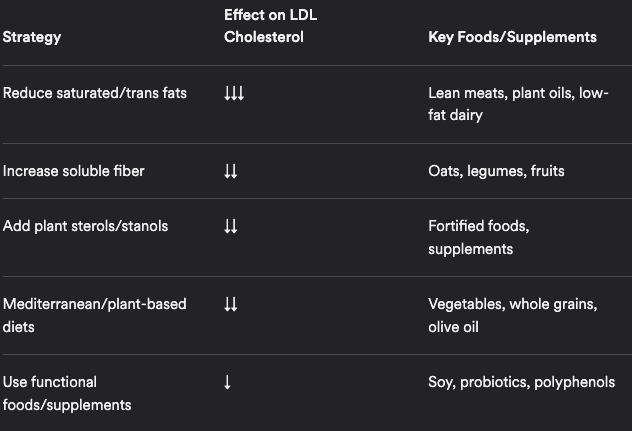
Figure 1: Summary of dietary strategies and their cholesterol-lowering effects. [2] [5] [6] [8] [9] [10] [14] [17] [18]
Practical Takeaways
Dietary cholesterol modestly raises LDL cholesterol, but saturated and trans fats have a much larger impact.
Focus on a dietary pattern rich in fruits, vegetables, whole grains, legumes, nuts, and healthy fats.
Use plant sterols/stanols, soluble fiber, and functional foods as adjuncts for additional cholesterol lowering.
For most people, moderate consumption of cholesterol-rich foods like eggs can fit into a healthy diet, especially when overall saturated fat intake is low.
Summary
Lowering cholesterol and lipid levels is not about restriction and deprivation - it is about nourishment and balancing our enjoyment foods with our healthful foods. Every meal is an opportunity to support your heart, your energy, and your long-term wellness. In summary, while dietary cholesterol does impact lab values, focusing on overall dietary patterns and proven nutritional strategies is the most effective way to manage cholesterol and support heart health.
At Wholehearted Nutrition and Wellness PLLC, we strongly believe that food is more than just fuel. It’s medicine, connection, enjoyment, and empowerment. We recognize why nutrition deserves center stage in cardiovascular disease management. If you’re interested in starting a heart healthy dietary pattern or learning how to manage your heart disease through nutrition, book an appointment with us today and begin your journey to better heart health.
References
1. Vincent, M., Allen, B., Palacios, O., Haber, L., & Maki, K. Meta-regression analysis of the effects of dietary cholesterol intake on LDL and HDL cholesterol.. The American journal of clinical nutrition. 2018; 109 1. https://doi.org/10.1093/ajcn/nqy273.
2. Berger, S., Raman, G., Vishwanathan, R., Jacques, P., & Johnson, E. Dietary cholesterol and cardiovascular disease: a systematic review and meta-analysis.. The American journal of clinical nutrition. 2015; 102 2. https://doi.org/10.3945/ajcn.114.100305.
3. Grundy, S. Does Dietary Cholesterol Matter?. Current Atherosclerosis Reports. 2016; 18. https://doi.org/10.1007/s11883-016-0615-0.
4. Fernandez, M., & Murillo, A. Is There a Correlation between Dietary and Blood Cholesterol? Evidence from Epidemiological Data and Clinical Interventions. Nutrients. 2022; 14. https://doi.org/10.3390/nu14102168.
5. Soliman, G. Dietary Cholesterol and the Lack of Evidence in Cardiovascular Disease. Nutrients. 2018; 10. https://doi.org/10.3390/nu10060780.
6. Stellaard, F. From Dietary Cholesterol to Blood Cholesterol, Physiological Lipid Fluxes, and Cholesterol Homeostasis. Nutrients. 2022; 14. https://doi.org/10.3390/nu14081643.
7. Carson, J., Lichtenstein, A., Anderson, C., Appel, L., Kris-Etherton, P., Meyer, K., Petersen, K., Polonsky, T., & Van Horn, L. Dietary Cholesterol and Cardiovascular Risk: A Science Advisory From the American Heart Association. . 2019; 141. https://doi.org/10.1161/CIR.0000000000000743.
8. Morenga, L., & Montez, J. Health effects of saturated and trans-fatty acid intake in children and adolescents: Systematic review and meta-analysis. PLoS ONE. 2017; 12. https://doi.org/10.1371/journal.pone.0186672.
9. Kirkpatrick, C., Sikand, G., Petersen, K., Anderson, C., Aspry, K., Bolick, J., Kris-Etherton, P., & Maki, K. Nutrition interventions for adults with dyslipidemia: A Clinical Perspective from the National Lipid Association.. Journal of clinical lipidology. 2023 https://doi.org/10.1016/j.jacl.2023.05.099.
10. Welty, F. Dietary treatment to lower cholesterol and triglyceride and reduce cardiovascular risk.. Current Opinion in Lipidology. 2020 https://doi.org/10.1097/MOL.0000000000000689.
11. Yanagisawa, R., He, C., Asai, A., Hellwig, M., Henle, T., & Toda, M. The Impacts of Cholesterol, Oxysterols, and Cholesterol Lowering Dietary Compounds on the Immune System. International Journal of Molecular Sciences. 2022; 23. https://doi.org/10.3390/ijms232012236.
12. Poli, A., Barbagallo, C., Cicero, A., Corsini, A., Manzato, E., Trimarco, B., Bernini, F., Visioli, F., Bianchi, A., Canzone, G., Crescini, C., De Kreutzenberg, S., Ferrara, N., Gambacciani, M., Ghiselli, A., Lubrano, C., Marelli, G., Marrocco, W., Montemurro, V., Parretti, D., Pedretti, R., Perticone, F., Stella, R., & Marangoni, F. Nutraceuticals and functional foods for the control of plasma cholesterol levels. An intersociety position paper. Pharmacological Research. 2018; 134. https://doi.org/10.1016/j.phrs.2018.05.015.
13. Ge, Q., Yan, Y., Luo, Y., Teng, T., Cao, C., Zhao, D., Zhang, J., Li, C., Chen, W., Yang, B., Yi, Z., Chang, T., & Chen, X. Dietary supplements: clinical cholesterol-lowering efficacy and potential mechanisms of action. International Journal of Food Sciences and Nutrition. 2024; 75. https://doi.org/10.1080/09637486.2024.2342301.
14. Neuenschwander, M., Hoffmann, G., Schwingshackl, L., & Schlesinger, S. Impact of different dietary approaches on blood lipid control in patients with type 2 diabetes mellitus: a systematic review and network meta-analysis. European Journal of Epidemiology. 2019 https://doi.org/10.1007/s10654-019-00534-1.
15. Berger, S., Raman, G., Vishwanathan, R., Jacques, P., & Johnson, E. Dietary cholesterol and cardiovascular disease: a systematic review and meta-analysis.. The American journal of clinical nutrition. 2015; 102 2. https://doi.org/10.3945/ajcn.114.100305.
16. Katcher, H., Hill, A., Lanford, J., Yoo, J., & Kris-Etherton, P. Lifestyle approaches and dietary strategies to lower LDL-cholesterol and triglycerides and raise HDL-cholesterol.. Endocrinology and metabolism clinics of North America. 2009; 38 1. https://doi.org/10.1016/j.ecl.2008.11.010.
17. Welty, F. Dietary treatment to lower cholesterol and triglyceride and reduce cardiovascular risk.. Current Opinion in Lipidology. 2020 https://doi.org/10.1097/MOL.0000000000000689.
18. Welty, F. Dietary treatment to lower cholesterol and triglyceride and reduce cardiovascular risk.. Current Opinion in Lipidology. 2020 https://doi.org/10.1097/MOL.0000000000000689.
19. Welty, F. Dietary treatment to lower cholesterol and triglyceride and reduce cardiovascular risk.. Current Opinion in Lipidology. 2020 https://doi.org/10.1097/MOL.0000000000000689.
20. Fernandez, M., & Murillo, A. Is There a Correlation between Dietary and Blood Cholesterol? Evidence from Epidemiological Data and Clinical Interventions. Nutrients. 2022; 14. https://doi.org/10.3390/nu14102168.