

Caffeine and Cardiology: What your Morning Cup Isn’t Telling You
From morning coffee rituals to energy drinks on the go, caffeine is a daily companion for millions of hard working adults around the world. But as its popularity grows, so do questions about its effects on cardiovascular health. Nothing encapsulates this concern better than the attention brought to caffeinated beverages after two individuals tragically passed following consumption of Panera Bread’s caffeinated Charged Lemonades back in 2023 and 2024. Caffeine, primarily consumed through coffee, tea, and energy drinks, is one of the world’s most popular stimulants. Few people know how much caffeine is considered a moderate intake, or even excessive. Its impact on heart disease—both in terms of development and management—has been the subject of extensive research, with findings that are nuanced and sometimes conflicting. Today we will delve into the research to understand how caffeine consumption can impact the heart and how we can utilize this stimulant to best support a heart-healthy lifestyle.
Caffeine and Heart Disease Risk
Moderate caffeine consumption (up to 400 mg/day) is generally not associated with increased risk of cardiovascular disease (CVD) in healthy adults. For reference, an 8 fl oz cup of coffee has around 95 mg of caffeine, while an 8 fl oz cup of black tea has around 47 mg. The caffeine content increases largely when we look at energy drinks, with Celsius and Prime Energy drinks having 200 mg per serving, or a 16 fl oz Bang energy drink having 300 mg.
Interestingly, several large observational studies and meta-analyses suggest that moderate caffeine consumption may be linked to an overall reduced risk of heart disease, heart failure, arrhythmias, and even overall mortality. The lowest risk is of development is often observed at moderate intake levels, with a U- or J-shaped relationship—meaning both very low and very high intakes may be less beneficial [1-8].
Mechanisms: How Might Caffeine Protect the Heart?
Recent research has uncovered potential mechanisms for caffeine’s cardio-protective effects. Based on a research 2022 study, caffeine may enhance cholesterol clearance by blocking SREBP2-induced hepatic PCSK9 expression, leading to increased LDL receptor activity and lower LDL cholesterol levels. It also appears that caffeine stimulates nitric oxide production, improving endothelial function and promoting vasodilation, both of which are beneficial for blood pressure and overall cardiovascular health [2,3,9,10].
Nuances and Limitations
Acute vs. Chronic Effects: While acute caffeine intake can temporarily raise blood pressure and increase arterial stiffness, these effects transitory and are not sustained with regular consumption in most generally healthy people [3,10-12].
Genetic Factors: Individual genetic differences in caffeine metabolism (fast metabolizers vs slower metabolizers) does not appear to significantly alter the relationship between caffeine intake and CVD risk. Individuals who are sensitive responders, often due to variants in the ADORA2A gene, may feel excessively anxious or stimulated with small doses of caffeine which may result in negative psychological outcomes and restriction of caffeine intake is recommended [8].
Confounding Factors: Some earlier studies linking caffeine consumption through coffee to increased risk of heart disease development may have been confounded by factors like smoking or sedentary lifestyle [3,7,13-15].
Special Populations: In hypertensive individuals, caffeine can cause short-term blood pressure spikes, but habitual coffee consumption does not seem to increase long-term CVD risk. Elderly individuals may benefit from moderate caffeine intake, but those with severe hypertension should be cautious [6,12].
Key Claims & Evidence
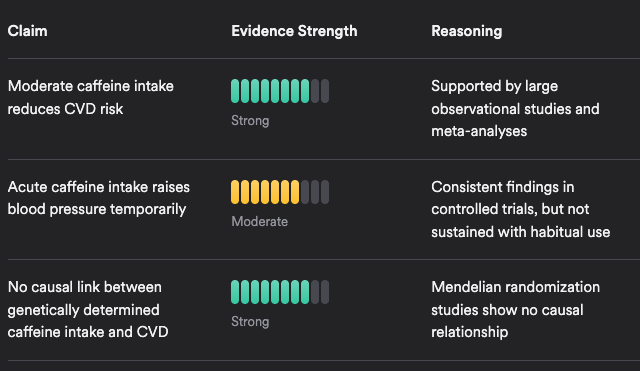
Figure 1: Summary of key claims and evidence on caffeine and heart disease [1-6,8,10-12,14,15].
Conclusion
Current evidence suggests that moderate caffeine supplementation— as in only a few cups of coffee or tea a day—is generally safe for most adults and may even offer cardio-protective benefits against heart disease development. However, the stimulant and protective effects can vary based on individual health status, genetics, and long-term consumption patterns. Those with severe hypertension or other heart-related risk factors should be cautious on the quantity of their regular caffeine consumption and consult with a healthcare provider before making significant changes to caffeine habits.
References
1. Dewland, T., Van Dam, R., & Marcus, G. Coffee and cardiovascular disease. European Heart Journal. 2025 https://doi.org/10.1093/eurheartj/ehaf421.
2. Lebeau, P., Byun, J., Platko, K., Saliba, P., Sguazzin, M., MacDonald, M., Paré, G., Steinberg, G., Janssen, L., Igdoura, S., Tarnopolsky, M., Chen, S., Seidah, N., Magolan, J., & Austin, R. Caffeine blocks SREBP2-induced hepatic PCSK9 expression to enhance LDLR-mediated cholesterol clearance. Nature Communications. 2022; 13. https://doi.org/10.1038/s41467-022-28240-9.
3. Ullah, E., Kunji, K., El-Menyar, A., Elsousy, R., Al-Nesf, M., Beotra, A., Al-Maadheed, M., Mohamed-Ali, V., Saad, M., & Suwaidi, J. Abstract 13039: Putative Protective Effects Of Caffeine And Its Metabolites On Coronary Heart Disease In The Middle East. Circulation. 2021 https://doi.org/10.1161/circ.144.suppl_1.13039.
4. Riksen, N., Rongen, G., & Smits, P. Acute and long-term cardiovascular effects of coffee: implications for coronary heart disease. Pharmacology & Therapeutics. 2009; 121 2. https://doi.org/10.1016/j.pharmthera.2008.10.006.
5. Surma, S., Sahebkar, A., & Banach, M. Coffee or tea: Anti-inflammatory properties in the context of atherosclerotic cardiovascular disease prevention.. Pharmacological Research. 2022; 187. https://doi.org/10.1016/j.phrs.2022.106596.
6. Tikhonoff, V., Ciaghi, G., Lievore, N., & Casiglia, E. Prognostic cut-off values of caffeine and cardiovascular events in a cohort of unselected men and women from general population. European Heart Journal. 2022 https://doi.org/10.1093/eurheartj/ehac544.2436.
7. Farraj, A., Akeredolu, T., Wijeyesekera, A., & Mills, C. Coffee and Cardiovascular Health: A Review of Literature. Nutrients. 2024; 16. https://doi.org/10.3390/nu16244257.
8.Chieng, D., Canovas, R., Segan, L., Sugumar, H., Voskoboinik, A., Prabhu, S., Ling, L., Lee, G., Morton, J., Kaye, D., Kalman, J., & Kistler, P. The impact of coffee subtypes on incident cardiovascular disease, arrhythmias, and mortality: long-term outcomes from the UK Biobank. European Journal of Preventive Cardiology. 2022 https://doi.org/10.1093/eurjpc/zwac189.
9. Cornelis, M., & El-Sohemy, A. Coffee, caffeine, and coronary heart disease. Current Opinion in Lipidology. 2007; 18. https://doi.org/10.1097/mol.0b013e3280127b04.
10. Said, M., Van De Vegte, Y., Verweij, N., & Van Der Harst, P. Associations of Observational and Genetically Determined Caffeine Intake With Coronary Artery Disease and Diabetes Mellitus. Journal of the American Heart Association: Cardiovascular and Cerebrovascular Disease. 2020; 9. https://doi.org/10.1161/jaha.120.016808.
Higashi, Y. Coffee and Endothelial Function: A Coffee Paradox?. Nutrients. 2019; 11. https://doi.org/10.3390/nu11092104.
11. Said, A., Vegte, Y., Verweij, N., & Harst, P. Associations of observational and genetically determined caffeine intake with coronary artery disease and diabetes. European Heart Journal. 2020; 41. https://doi.org/10.1093/ehjci/ehaa946.1493.
12. Nordestgaard, A., & Nordestgaard, B. Coffee intake, cardiovascular disease and all-cause mortality: observational and Mendelian randomization analyses in 95 000-223 000 individuals. International Journal of Epidemiology. 2016; 45 6. https://doi.org/10.1093/ije/dyw325.
13. Mesas, A., León-Muñoz, L., Rodríguez‐Artalejo, F., & López-García, E. The effect of coffee on blood pressure and cardiovascular disease in hypertensive individuals: a systematic review and meta-analysis. The American Journal of Clinical Nutrition. 2011; 94 4. https://doi.org/10.3945/ajcn.111.016667.
14. Lu, X., Zhu, X., Li, G., Wu, L., Shao, L., Fan, Y., Pan, C., Wu, Y., Borné, Y., & Ke, C. Habitual Coffee, Tea, and Caffeine Consumption, Circulating Metabolites, and the Risk of Cardiometabolic Multimorbidity. The Journal of Clinical Endocrinology and Metabolism. 2024 https://doi.org/10.1210/clinem/dgae552.
15. Greenberg, J., Dunbar, C., Schnoll, R., Kokolis, R., Kokolis, S., & Kassotis, J. Caffeinated beverage intake and the risk of heart disease mortality in the elderly: a prospective analysis. The American Journal of Clinical Nutrition. 2007; 85 2. https://doi.org/10.1093/ajcn/85.2.392.
16. Zulli, A., Smith, R., Kubatka, P., Novák, J., Uehara, Y., Loftus, H., Qaradakhi, T., Pohanka, M., Kobyliak, N., Zagatina, A., Klimas, J., Hayes, A., Rocca, G., Soucek, M., & Kruzliak, P. Caffeine and cardiovascular diseases: critical review of current research. European Journal of Nutrition. 2016; 55. https://doi.org/10.1007/s00394-016-1179-z.
17. Saimaiti, A., Zhou, D., Li, J., Xiong, R., Gan, R., Huang, S., Shang, A., Zhao, C., Li, H., & Li, H. Dietary sources, health benefits, and risks of caffeine. Critical Reviews in Food Science and Nutrition. 2022; 63. https://doi.org/10.1080/10408398.2022.2074362.
18. Van Dijk, R., Ties, D., Kuijpers, D., Van Der Harst, P., & Oudkerk, M. Effects of Caffeine on Myocardial Blood Flow: A Systematic Review. Nutrients. 2018; 10. https://doi.org/10.3390/nu10081083.
19. Higashi, Y. Coffee and Endothelial Function: A Coffee Paradox?. Nutrients. 2019; 11. https://doi.org/10.3390/nu11092104.
20. Zhou, A., & Hyppönen, E. Long-term coffee consumption, caffeine metabolism genetics, and risk of cardiovascular disease: a prospective analysis of up to 347,077 individuals and 8368 cases. The American Journal of Clinical Nutrition. 2019; 109 3. https://doi.org/10.1093/ajcn/nqy297.